Transcript:
Ronld Olaizola, Associate Director of Operations
We have the largest distribution network in New York.
Warehouse Professional
Carrots and cabbage are our last two.
Ronald
Our number one standard is making sure that we care.
Warehouse Professional
These look good. I like that.
Ronald
That we do everything with a sense of kindness.
Warehouse Professional
Keep up the good work.
Ronald
That is the standard by which we abide.
Warehouse Professional
That’s what I’m talking about.
Ronald
The transportation piece is the part that actually makes the magic happen.
The part that allows all this planning and preparation to come to fruition.
We have over 40 trucks, and we have over 40 drivers.
Deb Jones, Transportation Manager
How are you guys today?
Ronald
They show up every day, and they show up with smiles on their faces.
Warehouse Professional
Have a safe trip.
Deb
Thank you.
I find my job very rewarding.
I love what I do.
Go on and head out.
I love knowing that I’m helping people.
Ronald
Our drivers are modern-day heroes.
All of our trucks are equipped with state-of-the-art tracking components, which allow us to see where our trucks are, where they’ve been, and where they’re going in real time.
In addition, they have cameras and environmental monitors so that we make sure freezer and cooler items are maintained at the right temperature, and it’s being logged every minute of the day.
Making sure that the food is within the right temperature parameters is extremely important because if the food spoils, people don’t eat.
Deb
Yeah. I love hitting the road.
My dad used to drive school buses, so he used to bring me with him all the time.
So I think being in such big vehicles, I just felt comfortable.
We can average about six to eight stops on a truck.
Ronald
Sometimes they’re out on the road before the sun even comes out.
Deb
So we deliver to the Bronx, Queens, Manhattan, Brooklyn, and Staten Island.
It’s never a dull moment in the five boroughs.
Ronald
What makes New York City a difficult city to navigate is that the map of New York City was built almost 150 years ago.
Deb
And this is a 26-foot box truck.
So when you’re trying to maneuver through New York City streets, it’s not always that easy.
Ronald
Time is of the essence.
Heavy traffic is something that they face on a daily basis.
Deb
It can be a little bit of pressure.
Ronald
If we’re late, then that means that someone may not be able to get the food in time.
If they don’t get the food in time, then that means that some little boy or girl may not be having dinner that night.
Deb
That is my why.
Ronald
They sacrifice a lot of their time throughout the day because they work long hours, and they never complain about it.
They’re very eager to help others because some of our drivers understand what it means to experience hunger, and they also understand what it means to help fill in the gap.
Deb
Food insecurity, for me, hits home.
It’s a feeling of the unknown because you don’t know when your next meal is going to be.
When you know firsthand, it does give a different perspective, and it drives you to know that you’re doing something for someone so they don’t feel how you felt when you didn’t have anything.
Ronald
I would definitely say that the thing I’m most proud of when it comes to the transportation department is how we’ve grown.
We used to outsource to a third-party logistics team that would make the deliveries on our behalf.
What we decided as an organization is that we were going to bring everything in-house.
Being able to be more hands-on with the operation and having control has been transformational for this organization.
The most important thing that I think our drivers are delivering is happiness.
It’s hard to be happy when you’re hungry.
Deb
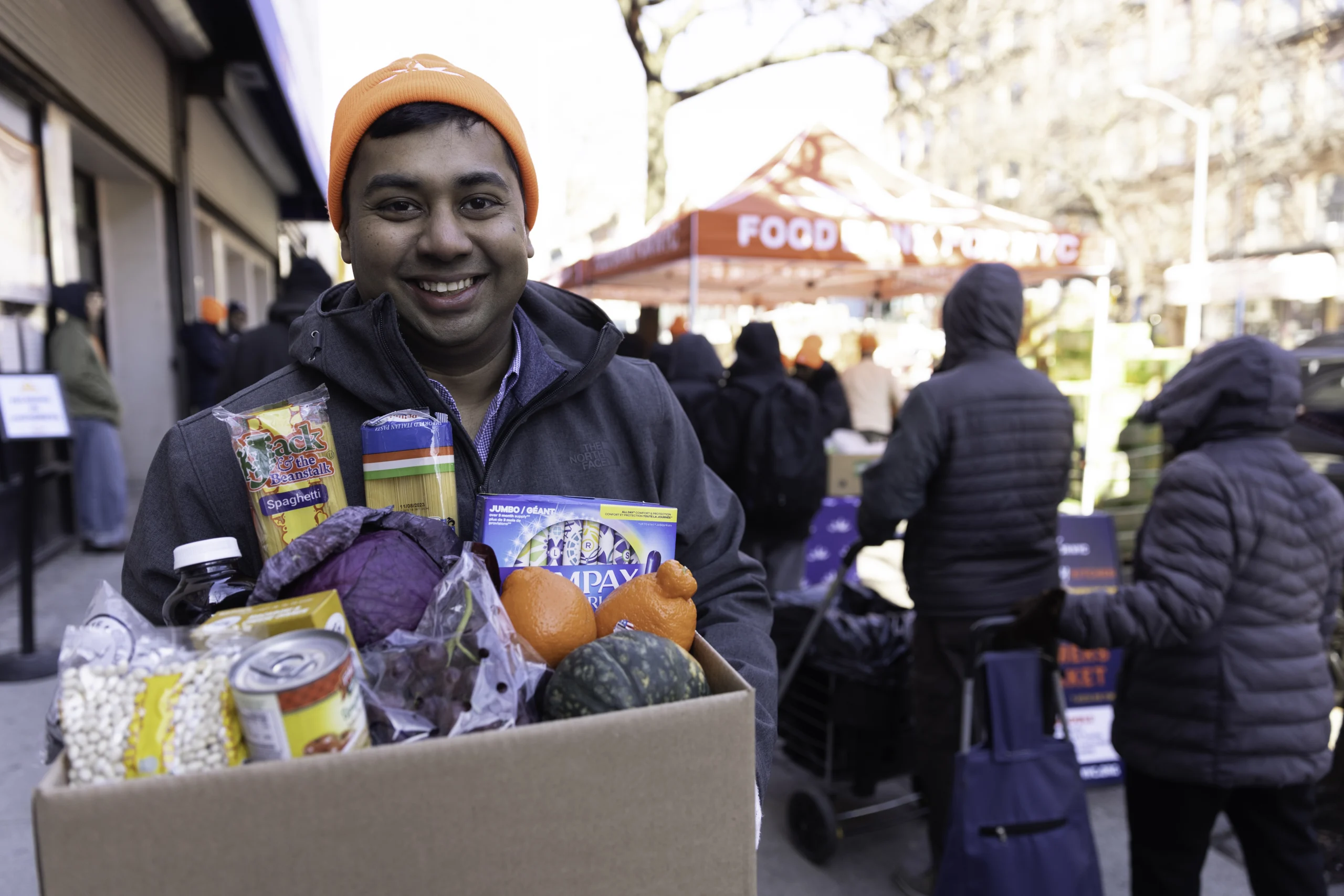
Here we have people waiting in line for the food that we’re about to deliver.
Ronald
The sheer amount of volume that we can actually put out and the number of people that we can feed absolutely makes us a worthy cause.
Warehouse Professional
It looks amazing. I can see it from here.
Ronald
What it takes to actually deliver the food that we receive takes real dollars that we need to utilize in order to bridge that gap for New Yorkers.
The impact of donor dollars for us on the transportation side is huge.
Warehouse Professional
Alright. Push it.
Ronald
Without them, we wouldn’t exist.
It would be impossible to complete our mission.
Transportation is the last mile.
[Deb] We’re delivering more than just food.
We’re delivering hope.
[Ron] Bridging the gaps between those that have and those that don’t.