Transcript:
Zanita Tisdale, Vice President of Agency and Organizational Impact:
New York City, one of the richest cities in the world and home to nearly 1.6 million hardworking New Yorkers facing hunger on every block and in every borough. Since 2020, New Yorkers have overcome challenge after challenge.
Hunger outlasted them all.
The emergency food crisis is still here, and it’s only getting worse. Hi. I’m Zanita, Vice President of Agency and Organizational Impact at Food Bank for New York City, our city’s largest hunger relief organization. Recent federal policy brought sweeping changes to SNAP, the program once known as food stamps, that puts nutritious food on tables across America. Since June 2025, nearly 120,000 New York City residents have lost access to their food benefits, driven by red tape, confusion, and fear with the greatest impact falling on local communities and their economies. Our emergency food network stands in the gap. For New Yorkers trying to keep a roof over their head and food in their stomachs, New Yorkers like Jo Ann.
Jo Ann:
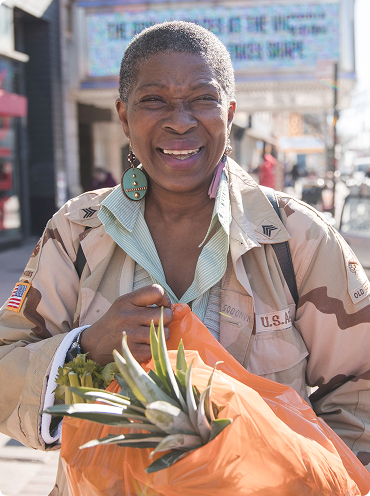
Hello. Hello. The last ten days of the month, we’re down to, like, nothing in our refrigerator. I’m on public assistance.
I lost my job. I’ve always worked all my life. I, lost my job in 2020 and couldn’t find a job. Sent out over eight thousand applications.
I’ve been in HR for over twenty five years. And then they changed the rules for the work requirements. ABAWD came in. So I had to look for volunteer work, and I got into the SNAP call center.
Thank you for calling the food bank. How can I help you? I actually love doing it because I’ve always worked in HR. I’ve always wanted to work and help people in all sorts of matters, and I and I can connect with these people that are calling me because I get SNAP.
So I understand their their you know, I understand their frustration. I understand their sadness and discouragement. I understand how HRA works. Okay.
So I’m gonna I’m gonna ask you some information. I’m gonna need your name, first of all. If I can do a SNAP screening and I can help a person get their benefits by advising them how, you know, how to navigate the process, I am very happy doing that because, you know, everything is very expensive, but it is terrible that no one should be going hungry in this city. With so much money that that’s out there, no one should be suffering like this.
Nobody.
Zanita:
Jo Ann is not alone. She is one of hundreds of thousands of New Yorkers on SNAP who must now meet new work requirements to keep their food benefits. And volunteering with Food Bank for New York City helps her to do just that.
Joanne feels fortunate. She has the safety net of SNAP and she can meet the new work rules, but many cannot. And it’s not just New Yorkers who are feeling the squeeze. Every SNAP dollar lost is a dollar lost at the register.
And for many local businesses, those dollars are the difference between staying open and closing for good.
Radhames:
New York without bodegas is not gonna be New York.
New Yorker:
I love my bodegas!
Radhames:
The bodegas, they have the big connection with the community. That we feeling the same thing the community feeling. My neighbor because that’s those my neighbor.
People who that I’m serving, that’s that’s my family. He treats everybody with a good heart. It’s a connection that we have that I like, I feel the same thing she felt because we come in for the same thing, for for for a family, for poor people, and we’re there sharing the the same situation they have.
That’s the way that’s the same thing I feel. Cutting the SNAP for the community is cutting a lot of other stuff is because those customers that are they used to go to the store, they are spending, let’s say, a hundred dollars. Now they’re gonna spend maybe fifty dollars. So that’s less income to the store. Then how we’re gonna pay the rent, how we’re gonna pay the electricity, and all the the the the expenses that we have in the store is is depending on how much we’re earning. If we would got cut off for over forty, fifty, sixty percent, of our gross sales, so then we’re not gonna be able to survive.
Zanita:
If you think this doesn’t affect you because you’re not on SNAP, listen to how this will affect the New York state budget.
Barbara:
My summary is that none of it is good for New York state or New York state residents. Right now, we’re predicting the federal cost shifts will result in about a 1.3 billion dollar increase in cost for New York State and New York State counties. And that breaks down into two components. Part of it is administration, and then the much larger cost is to actually fund a portion of the SNAP benefits.
So the feds have decided that the cost shift for any state, the percentage you pay is based on what is referred to as a payment error rate. And at the federal level, this is being touted as waste, fraud, and abuse in the system, which is absolutely not what the payment error rate is. What the payment error rate measures is really just it could be relatively small mistakes that are made either by case workers who are processing benefits or by households who may report a change in their household circumstances, but maybe a little bit later than they needed to. So they’re really, it’s not fraud, they’re administrative errors.
In addition to just the fact that’s a lot of money that New York State could invest in other services. The SNAP program was designed with the federal government paying the benefits. Again, that’s because the federal government’s budget doesn’t need to be balanced every year. It can grow during times of economic downturn, and then it can contract like the SNAP program does during positive economic times where there are fewer people who need help.
That’s not the case at the state level. You know, every year, New York State must balance its budget. So if the state has to contribute over billion dollars to supporting SNAP, it really reduces opportunities for how New York taxpayer dollars are used to deliver services in New York State.
Zanita:
This is heavy. We know. But we also know what this city can do together so that no one, not Jo Ann, not the bodega on your corner, not the family on your block has to carry the weight of hunger alone. Food alone won’t end hunger, but people will.
So here’s where you come in. Go to foodbanknyc.org and sign our petition. Call your representatives. As SNAP changes push more families to our pantry lines, it’s going to take all of us showing up for our city.
It takes a city to feed one, and that city is you.