Transcript:
Narrator
You might not see it, but hunger lives here.
Not far away, right here, in New York City, in every borough, on every block.
The kid sitting next to you on the train? Yeah.
The mom behind you in line at the store? Her too.
In the richest city in the world, over a million New Yorkers go to bed hungry.
But when you step up, something powerful happens.
Your gift fuels strength, restores dignity, and helps build a city where no New Yorker has to face hunger alone.
We want every donor to see their gift in action.
So come with us.
Our food comes from many places, but often it starts here at a farm just north of the city.
Corn, onions, carrots—you name it. We know someone that grows it.
Because here’s the thing: New Yorkers aren’t one-size-fits-all.
Bob Silvia, Chief Procurement Officer
New York is not cookie cutter.
Narrator
We don’t just grab what’s available, we grab what matters.
Halal for the family in Queens, kosher for Grandpa in Brooklyn, plantains for the mom in the Bronx.
Because food isn’t just fuel.
Food is home.
Bob
Food insecurity is only solved if you eat the food we give you. So I have to be specifically tied in to the cultural relevance of what we’re bringing in.
Narrator
We also rescue perfectly good food from farms, stores, and markets.
Food that would have gone to waste, now in the hands of New Yorkers who need it most.
Bob
We grow enough food in the United States and in the world for there not to be any hunger. We just need to be more efficient at getting it to the people who need it.
Narrator
Next stop, the Boogie Down Bronx.
Did you know the Hunts Point Cooperative Market is the largest food distribution center of its kind in the world?
It’s also home to our 90,000-square-foot warehouse.
Millions of pounds flow through these doors every month.
Elizabeth Romano, Senior Director of Operations
On average, we receive about 12 to 15 tractor-trailers worth of food. On the heavier days, it’s between 20 to 23.
Narrator
Trucks roll in packed with produce, meat, dairy, fish, and dry goods like beans and flour.
Anything you find in a grocery store, we got it.
Our team sorts it, stages it, and gets it moving in a New York minute.
Elizabeth
I’m absolutely proud of this team.
Narrator
What other food banks might turn away? We say, “Bring it on.”
Nothing gets wasted.
Not on our watch.
From Hunts Point, your donation hits the streets.
One mission, 40 trucks, all five boroughs.
Every neighborhood, from Bed-Stuy to Morris Park.
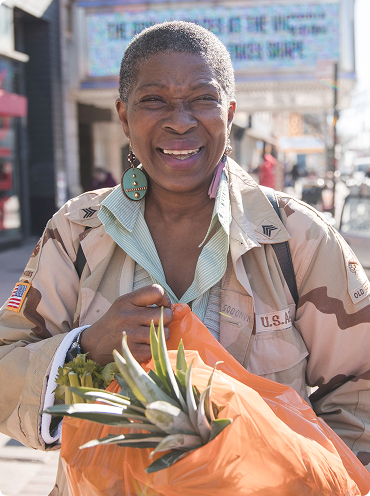
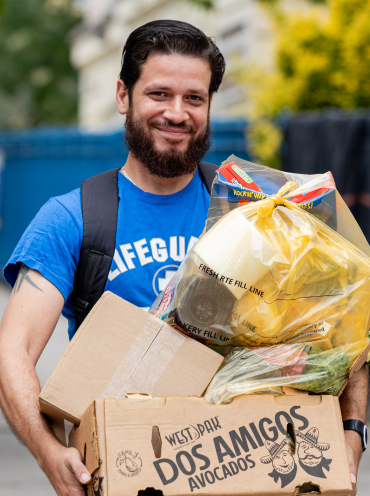
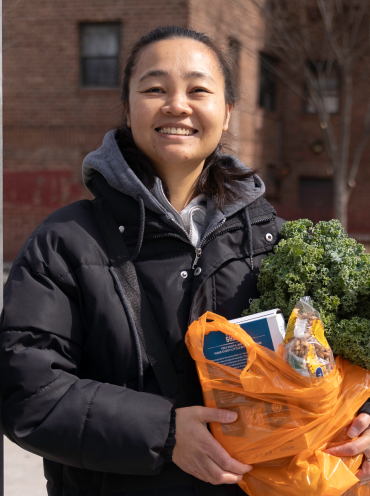
We deliver food and support to 800 partners across the city—soup kitchens, mobile pantries, college campuses, community centers.
And we do it faster than Amazon.
Yes. Really.
Jeff Daughtry, Manager of Warehouse Operations
Basically, Food Bank for New York City works no matter the weather. We’re here supplying.
Narrator
Because when someone’s choosing between food and rent, speed isn’t just logistics, it’s survival.
Deb Jones, Transportation Manager
What sets us apart from the rest, honestly, is that we know that we’re helping people, and that goes a long way. You know, it’s not your average, like, “Oh, let me just deliver to a supermarket. Let me just deliver to a warehouse.” We’re actually delivering to people that are in need.
Narrator
Wherever New Yorkers are, we meet them there.
When it reaches a kitchen or pantry, it becomes a hot meal.
A moment of relief, a chance to gather, connect, and breathe.
At our community kitchen in West Harlem, we serve over 100,000 meals a month.
Monique, Educator
People are in situations and circumstances that they’re in not necessarily because of something they did. You know, you see a lot of people who are just making it day by day and check by check, just like I am.
Narrator
But your gift does more than fill a plate.
It helps families sign up for SNAP, take nutrition classes, and learn what food security actually feels like.
Monique
When I wash those dishes, I’m like, “Thank you, Lord. Great. Another meal, another day.”
Mhmm. That’s right.
Narrator
From farms to food banks to hardworking New Yorkers—that’s the journey.
But it’s not the end.
It’s the start of something better.
Bob
If you give me five dollars or you give me five hundred thousand dollars, my commitment to that donation is the same. I want to make sure I’m getting the freshest product, the most amount of pounds. I want it transported responsibly, and I want the labor to be fair. And I want no dollar to go to waste. I will negotiate down to the final penny to make sure that none of that is wasted.
Narrator
It takes a city to feed one, and that city—it’s us.
So are you in?